

- Your cart is empty
- Continue shopping
Structured Water: What Nature Teaches Us About Water, Movement and Modern Infrastructure
-
webmaster
- Posted on
- Categories:Water Quality
- 0 comments
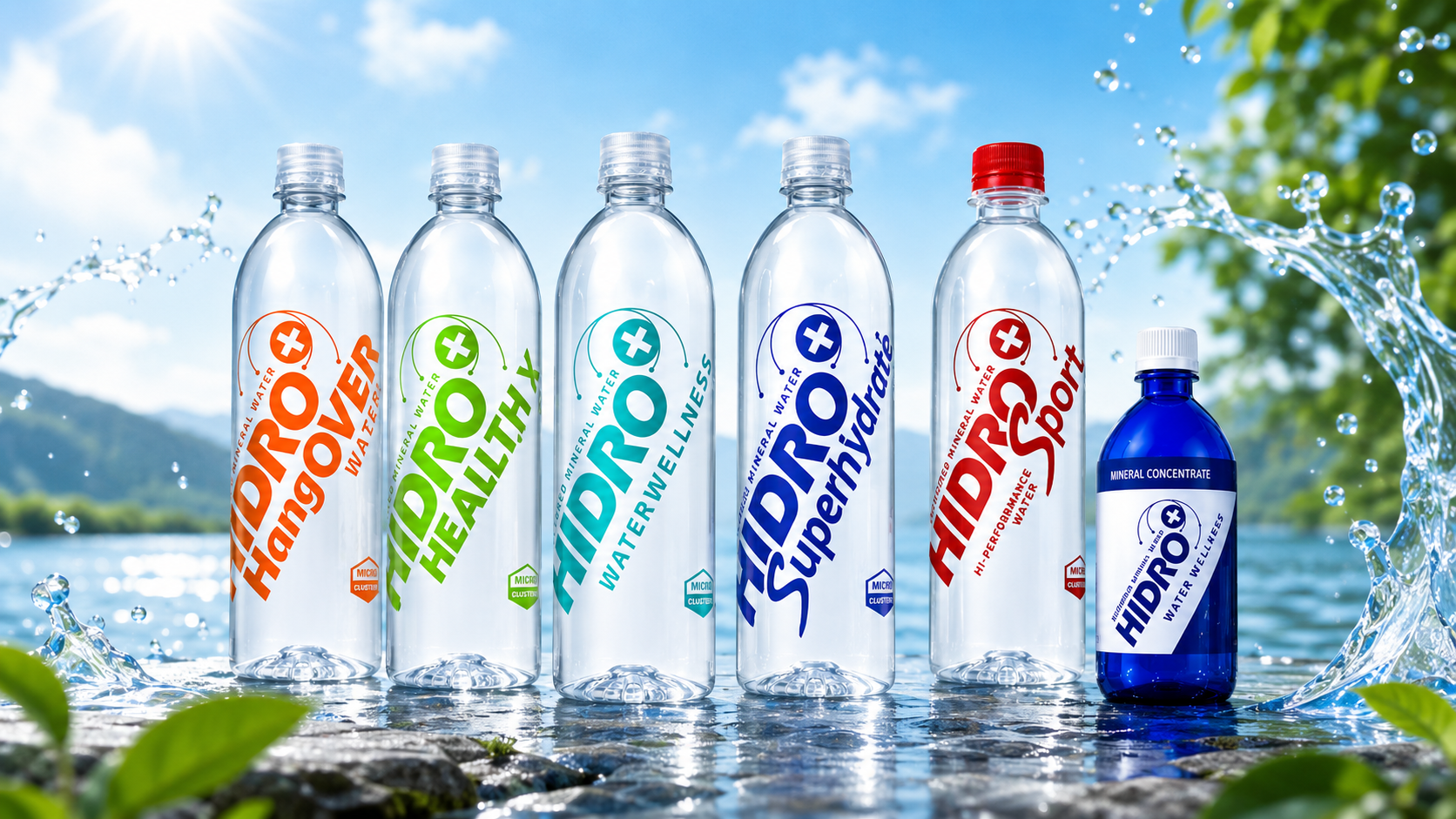
Water is more than a chemical formula
When we write water as H₂O, we describe its chemical composition: two hydrogen atoms bonded to one oxygen atom. But the formula does not describe everything occurring in a glass of water.
A water molecule has an angular shape, with an H–O–H bond angle of approximately 104.5 degrees. Because oxygen attracts electrons more strongly than hydrogen, one side of the molecule carries a partial negative charge while the hydrogen side carries partial positive charges. Water is therefore a polar molecule.
This polarity allows neighbouring water molecules to attract one another through hydrogen bonds. In liquid water, vast numbers of these bonds are continually forming, breaking and reforming, creating a three-dimensional and constantly changing network.
Water is therefore not a collection of isolated H₂O molecules floating independently. It possesses local molecular organisation. Around each molecule, neighbouring molecules tend to adopt arrangements influenced by hydrogen bonding, temperature, pressure, dissolved minerals, surrounding surfaces and other conditions. This local organisation contributes to water’s unusual properties, including its surface tension, heat capacity, solvent behaviour and the fact that ice is less dense than liquid water.
That is the legitimate scientific starting point for discussing water structure.
Water has structure—but not a permanent molecular architecture
The word “structured” can create the impression that water molecules lock themselves into permanent microscopic snowflakes or stable hexagonal clusters. Bulk liquid water does not normally behave in that way.
Its hydrogen-bond network is extraordinarily dynamic. Spectroscopic studies and molecular simulations indicate that individual hydrogen bonds and local arrangements reorganise over femtosecond and picosecond timescales—a picosecond being one trillionth of a second. One advanced simulation estimated a hydrogen-bond lifetime of approximately 0.78 picoseconds, while ultrafast spectroscopy has observed rapid loss of structural correlations followed by energy dissipation through the wider network within a few picoseconds.
This has an important implication:
Water can respond to its environment, but ordinary bulk water also relaxes and reorganises extremely quickly.
Scientists can detect local organisation, hydration shells around ions, ordered water near surfaces and transient responses to applied energy. That is different from claiming that water retains a permanent memory of every pipe, pump, sound or electromagnetic field it has encountered.
The most responsible use of the term structured water is therefore to describe water that has been exposed to a process intended to influence measurable physical organisation or physicochemical behaviour—not water that has been proven to possess a permanent new molecular identity.
The natural journey of spring water
Natural spring water begins long before it appears at the surface.
Rainwater infiltrates soil, sediment and fractured rock. During its underground journey, it encounters minerals, organic materials, microorganisms and gases. Depending on the local geology, it may dissolve calcium, magnesium, bicarbonate, silica, sodium, iron, manganese and other substances.
Groundwater quality is therefore strongly influenced by:
- The mineral composition of the surrounding rock
- The depth and age of the groundwater
- Temperature and pressure
- The amount of oxygen present
- Contact with soil and organic material
- Agricultural, industrial and urban contamination
- The time the water remains underground
All natural waters contain some dissolved substances derived from their contact with soils, rocks and the atmosphere. Cooler water can generally retain more dissolved gas than warmer water, while groundwater chemistry can vary substantially from one geological formation to another.
When spring water emerges and begins moving over rocks, through channels or down a mountain slope, further changes occur. It can exchange gases with the atmosphere, entrain air, lose dissolved carbon dioxide, change temperature and experience turbulence and mixing.
These processes can affect measurable characteristics such as:
- Dissolved oxygen
- Carbon dioxide concentration
- pH
- Mineral precipitation
- Oxidation-reduction potential
- Temperature
- Taste and aroma
- Microbial composition
This is a more scientifically defensible understanding of “living” natural water. Its distinctiveness arises from its source, mineral history, temperature, gas content, biological environment and movement through nature.
Natural does not automatically mean safe
Romanticising spring water can also be dangerous. A clear, cold mountain spring may contain disease-causing microorganisms or naturally occurring chemicals such as arsenic, fluoride, iron or manganese. Wells and springs have repeatedly been identified as possible sources of waterborne infection.
Natural water can be exceptional—but appearance, taste and origin alone cannot confirm its safety. Proper testing remains essential.
The water our forefathers drank
For most of human history, people obtained water relatively close to its source: from springs, streams, wells, rainwater systems or local boreholes.
In rural South Africa, windpumps became a familiar means of lifting groundwater to the surface. Historical records place early windpumps in the country during the nineteenth century, with imported steel windpumps becoming increasingly important to farms and rural settlements around the late nineteenth and early twentieth centuries.
Water drawn in this way often followed a simpler route:
Borehole → windpump → storage tank → household or livestock trough
Modern municipal water may follow a far more complex route:
River, dam or borehole → treatment works → chemical treatment → high-capacity pumps → reservoirs → pressure zones → kilometres of mains → valves and bends → building plumbing → household tap
It is reasonable to say that these journeys are different. It is not yet reasonable to conclude that the older route automatically produced a permanently superior molecular structure.
Our forefathers’ water may have experienced:
- Less chemical disinfection
- Shorter distribution distances
- Fewer artificial surfaces
- Lower flow velocities
- Less high-pressure pumping
- More direct contact with local geology
But it could also have contained:
- Faecal contamination
- Parasites and pathogens
- Sediment
- Agricultural contamination
- Naturally occurring metals
- Animal waste
- Unsafe storage contamination
Modern treatment arose largely because untreated natural water caused serious disease. Any honest comparison must acknowledge both sides.
What modern treatment and distribution can change
Municipal treatment is designed primarily to produce water that is microbiologically and chemically acceptable—not to reproduce the sensory or mineral characteristics of a mountain spring.
Depending on the source and treatment plant, processes may include:
- Coagulation and flocculation
- Sedimentation
- Filtration
- Chlorination or chloramination
- Ozone or ultraviolet treatment
- pH adjustment
- Corrosion control
- Fluoridation in some jurisdictions
- Storage and redistribution
Once treated water enters a distribution network, it continues to interact with its environment.
The United States Environmental Protection Agency recognises that distribution-system water quality can change through water age, microbial growth, biofilms, sediment, disinfectant decay, disinfection by-product formation, corrosion, pressure changes, leaching and storage conditions.
For example:
- Disinfectants can react with naturally occurring organic material.
- Disinfectant residuals can decrease as water ages.
- Biofilms may develop on internal pipe surfaces.
- Corrosion can release metals from pipes and fittings.
- Temperature can rise during storage and distribution.
- Pressure transients and leaks can create opportunities for contamination.
- Water chemistry may differ between the treatment-plant outlet and the consumer’s tap.
These are established, measurable changes. They offer a much stronger basis for comparing modern tap water with source water than claims about invisible molecular damage.
Do hundreds of pipe bends damage water?
A pipe bend changes the direction of flow. This produces secondary flow patterns, turbulence and pressure losses. NIST and other engineering research organisations study these effects because pipe fittings alter velocity distribution and dissipate hydraulic energy.
A complex distribution network can therefore expose water to repeated:
- Changes in velocity
- Pressure drops
- Turbulence
- Friction
- Contact with pipe surfaces
- Mixing between water of different ages
- Entrained or dissolved gases
These effects matter for hydraulic efficiency, contaminant transport, corrosion, sediment movement and sometimes taste.
However, the statement that every bend “breaks” the natural molecular structure of water and leaves it permanently disorganised goes beyond the evidence. Turbulence certainly rearranges water molecules while it occurs, but the hydrogen-bond network in liquid water is already reorganising trillions of times per second.
The scientifically defensible conclusion is:
Pipe networks change water’s physical journey and may alter measurable water-quality parameters, but persistent molecular damage from bends alone has not been demonstrated.
What centrifugal pumps do to water
A centrifugal pump uses a rapidly rotating impeller to transfer mechanical energy to water. It increases water velocity and pressure so that large volumes can be transported over long distances or lifted to higher elevations.
Inside the pump, water can experience:
- Rapid acceleration
- Shear forces
- Pressure gradients
- Turbulence
- Vibration
- Heat generation
- Interaction with the impeller surface
When local pressure falls sufficiently, cavitation may occur. Vapour cavities or bubbles form in low-pressure zones and collapse when they enter regions of higher pressure. Cavitation can produce vibration, noise, pressure pulses and erosion of pump components. It is a major engineering concern in centrifugal-pump design and operation.
Severe cavitation can also influence:
- Gas release and entrainment
- Particle dispersion
- Local temperature
- Oxidation processes
- Equipment wear
- Metal release from damaged surfaces
But once again, care is required. Even when high-energy pumping temporarily disturbs the local hydrogen-bond network, bulk water reorganises rapidly after the mechanical disturbance ends.
Centrifugal pumping can materially affect water’s hydraulic and physicochemical conditions, particularly if cavitation or aeration occurs. It has not been proven to turn water into a permanently biologically inferior molecular form.
Can sound and vibration influence water?
Sound is a pressure wave travelling through matter. Water responds physically to sound because variations in pressure cause its molecules to move.
At ordinary environmental sound levels—voices, traffic, machinery or music—the energy transferred to a container of water is comparatively small. There is no convincing evidence that ordinary sound produces a persistent molecular arrangement after the sound stops.
High-intensity ultrasound is different. It can generate acoustic cavitation, microstreaming, strong local shear and extremely energetic bubble collapse. Ultrasound is used in chemistry, medicine, cleaning, food processing and water treatment precisely because sufficiently powerful sound can cause measurable physical and chemical effects.
The crucial distinction is therefore between:
- Ordinary audible sound, which causes weak pressure oscillations; and
- Controlled high-energy acoustic treatment, which may generate cavitation and measurable chemical or physical change.
The mere fact that water responds to vibration does not establish that all noise damages it—or that playing harmonious music permanently improves it.
What about electromagnetic fields?
Because water is polar, electric fields can influence molecular orientation. Dissolved ions also respond to electric and magnetic forces.
Under sufficiently strong and carefully controlled laboratory conditions, electric, magnetic, infrared and terahertz fields can produce detectable responses in water. Researchers have observed ultrafast reorientation, transient disruption of hydrogen bonding and changes in spectroscopic behaviour during or immediately after strong-field exposure. A 2025 terahertz study, for example, reported transient disruption and reorganisation of the hydrogen-bond network following intense terahertz pulses.
Research into magnetic water treatment is less consistent.
Some studies report changes in:
- pH
- Oxidation-reduction potential
- Dissolved oxygen
- Surface tension
- Crystallisation behaviour
- Raman or infrared spectra
- Scale formation
One controlled experiment using permanent magnets and very slow flow reported modest changes in pH, oxidation-reduction potential and dissolved oxygen, together with changes interpreted from Raman spectroscopy.
Other research has found no measurable alteration in purified water after magnetic treatment. A 2006 study reported no change in pure water distilled from ultrapure water under vacuum, while a critical review of electromagnetic water-treatment systems found that outcomes depended strongly on water chemistry, flow rate, equipment design and operating conditions. Some pilot-scale tests showed no effect in potable water or seawater.
This mixed evidence leads to a careful conclusion:
Applied fields can interact with water and dissolved substances under specific conditions. Whether a particular commercial device creates a meaningful, persistent and independently reproducible change must be established for that specific device.
The presence of a frequency, magnet, crystal or electromagnetic component does not by itself prove restructuring.
How frequency-based water conditioning is proposed to work
Frequency-based structuring systems vary considerably. Some use magnetic fields, electromagnetic pulses, acoustic vibration, vortex motion, infrared energy, mineral media, ceramics or combinations of these.
The general proposed sequence is as follows.
- Water enters the treatment zone
The starting water has a particular temperature, mineral composition, pH, conductivity, dissolved-gas concentration and flow rate.
These variables matter. A process that produces a measurable result in deionised water may not behave in the same way in mineral-rich borehole water or chlorinated municipal water.
- An external field or vibration is applied
The system exposes the water to a controlled stimulus, such as:
- A static magnetic field
- A pulsed electromagnetic field
- An alternating electric current
- Acoustic vibration
- Infrared or other electromagnetic energy
- Vortex movement
- Contact with an activated or mineral-based surface
The proposed interaction may involve the orientation of polar molecules, movement of dissolved ions, changes around hydration shells, gas exchange, nucleation behaviour or interaction with surfaces.
- Water and dissolved substances respond
During exposure, changes could occur in:
- Molecular orientation
- Ion movement
- Mineral nucleation
- Gas-bubble formation
- Dissolved oxygen
- Surface tension
- Oxidation-reduction potential
- Spectroscopic signatures
Not every change necessarily represents a new molecular structure. For example, a change in pH may result from carbon dioxide loss, temperature variation, electrode behaviour or mineral reactions rather than a persistent reorganisation of pure H₂O.
- Water leaves the treatment zone
The critical scientific question now becomes:
How long does the measured effect persist?
Because liquid water reorganises rapidly, researchers must distinguish between:
- A response that exists only while the field is applied
- A change that lasts seconds or minutes
- A change caused by aeration, temperature or mineral precipitation
- A genuinely persistent physicochemical difference
- Before-and-after testing is required
A credible frequency-conditioning system should ideally be tested for:
- Temperature
- pH
- Electrical conductivity
- Total dissolved solids
- Dissolved oxygen
- Oxidation-reduction potential
- Surface tension
- Turbidity
- Mineral composition
- Particle-size distribution
- Raman or infrared spectra
- Nuclear magnetic resonance measurements where appropriate
- Changes immediately after treatment and at later intervals
The testing should include untreated controls and should preferably be performed independently and blindly.
Without this information, statements about “restructuring” remain conceptual rather than demonstrated.
The Masaru Emoto water-crystal experiments
Masaru Emoto was a Japanese author and popular water researcher who became internationally known for photographs of frozen water crystals.
In his demonstrations, water samples were reportedly exposed to words, intentions, prayers or different types of music. Drops were then frozen and photographed under magnification. Samples associated with positive words or harmonious music were said to produce attractive, symmetrical crystals, while samples associated with negative words or harsh music were said to form irregular or incomplete crystals.
The images are striking and have inspired widespread discussion about consciousness, intention and the sensitivity of water.
However, they must be described accurately.
They are images of ice—not liquid-water molecules
The photographs show macroscopic ice-crystal formations. They do not reveal individual H₂O molecules or directly show the molecular structure of liquid water.
Ice formation is sensitive to numerous variables, including:
- Freezing rate
- Temperature gradients
- Impurities
- Dust and nucleation sites
- Dissolved minerals
- Dissolved gases
- Sample volume
- Container surface
- Timing of photography
- Which crystals are selected for presentation
Controlled studies reported interesting—but limited—results
A double-blind study involving Emoto and researchers from the Institute of Noetic Sciences reported that judges gave higher aesthetic ratings to ice crystals produced from intentionally treated water than to control crystals. A later triple-blind replication involving approximately 1,900 participants and more than 2,500 independent judges reported a smaller difference, with a one-tailed probability value of 0.03 against proximal controls.
These studies deserve to be represented fairly. They reported an association in subjective ratings under their experimental procedures.
But they do not prove that:
- Words permanently reorganise liquid water
- Water understands language
- Water stores emotional memory
- Positive intention changes water’s chemical formula
- Drinking intention-treated water improves health
The measured outcome was the aesthetic rating of selected frozen-crystal photographs, not a direct measurement of liquid-water molecular organisation or human health.
Emoto’s work is best presented as an intriguing invitation to investigate water more carefully—not as settled molecular science.
Recommended caption for an Emoto image
Selected frozen-water crystals attributed to Masaru Emoto’s experiments. These photographs show ice formations after freezing, not individual water molecules. Although Emoto associated different crystal appearances with words, music and intention, his interpretations have not been established as a general scientific property of liquid water.
That caption allows Hidro+ to include the images without misleading the reader.
The water within the human body
Water is indispensable to human life. It functions as:
- A solvent for biochemical reactions
- A transport medium for nutrients and waste
- A component of blood and intracellular fluid
- A regulator of body temperature
- A participant in digestion and metabolism
- A lubricant and protective fluid
- A medium for electrolyte and nerve function
Total body water varies with age, sex, muscle mass and body-fat percentage. A commonly used approximation is approximately 60% in adults, around 65% in children and approximately 70% or more in infants, with some newborns reaching higher levels.
The fact that the body contains a large proportion of water makes water quality important. It does not, by itself, prove that externally frequency-conditioned water produces a special physiological effect.
For health and hydration, the strongest established priorities remain:
- Microbiological safety
- Acceptable chemical quality
- Adequate fluid intake
- Appropriate electrolyte balance
- Suitable mineral composition where relevant
- Clean storage and distribution
Whether frequency conditioning adds a further measurable benefit remains a separate research question.
Then and now: the real difference
The strongest comparison between historical natural water and modern drinking water is not a simple contest between “living” and “dead” water.
It is a comparison between two very different journeys.
Water closer to nature
Historically sourced water may have been:
- Closer to its geological source
- Naturally mineralised
- Cooler
- Less chemically treated
- Transported over shorter distances
- Exposed to gravity-driven flow, streams or local pumping
- Consumed soon after collection
It may also have carried substantial microbial and chemical risks.
Modern distributed water
Modern municipal water is more likely to have been:
- Treated to control pathogens
- Filtered and disinfected
- Stored for extended periods
- Pumped at high capacity
- Transported through long pipe networks
- Exposed to pipe surfaces, pressure changes and water ageing
- Chemically stabilised for distribution
It may be microbiologically safer while differing from source water in taste, dissolved gases, mineral balance and other measurable characteristics.
This is the substance of the structured-water conversation:
Has our ability to disinfect, store and transport water changed some of the qualities that people historically associated with fresh, naturally moving water?
The answer is undoubtedly yes in relation to mineral content, temperature, dissolved gases, treatment residuals, water age and pipe interaction.
Whether modern infrastructure also leaves a persistent and biologically significant molecular signature remains unproven.
A responsible Hidro+ perspective on structured water
At Hidro+, water quality can be considered through three separate but complementary questions.
- Is the water clean?
Structuring is not filtration.
A frequency device cannot be assumed to remove pathogens, pesticides, pharmaceuticals, heavy metals, microplastics or disinfection by-products unless validated treatment technology is included and independently tested.
Purification must come first.
- Is the water appropriately mineralised?
Reverse osmosis is highly effective at removing many dissolved contaminants, but it also removes most dissolved minerals.
Remineralisation can influence:
- Taste
- Conductivity
- Alkalinity
- Calcium and magnesium content
- pH stability
- Interaction with plumbing and containers
These are measurable effects and should not be confused with molecular structuring.
- Has the water undergone physical conditioning?
A structuring or conditioning stage may expose purified and mineralised water to a controlled frequency, field, surface or movement pattern intended to influence its physical behaviour.
This is the most scientifically careful way to describe the process:
Hidro+ applies a physical conditioning stage intended to influence the organisation and energetic state of water after purification and mineralisation. Water is inherently responsive to temperature, pressure, surfaces, dissolved minerals and applied energy. Research into frequency- and field-conditioned water has reported measurable effects under certain experimental conditions, although the nature, persistence and biological significance of these effects remain areas of continuing investigation.
This wording explains the concept without making a medical promise.
Conclusion: water’s journey matters
Natural water and modern tap water may share the same basic chemical formula, but they do not necessarily share the same history or measurable properties.
Spring water has interacted with rainfall, rock, minerals, soil, gases, temperature, pressure and natural movement.
Municipal water has interacted with treatment chemicals, filters, pumps, reservoirs, pressure zones, pipes, valves, storage systems and building plumbing.
Those journeys can influence:
- Mineral composition
- Dissolved gases
- pH
- Oxidation-reduction conditions
- Temperature
- Taste
- Microbiology
- Surface interactions
- Corrosion behaviour
- Disinfection by-products
Science also confirms that water possesses a complex and constantly changing hydrogen-bond network. It can respond to strong mechanical, electrical, magnetic and electromagnetic influences under controlled conditions.
What science does not yet establish is that ordinary modern infrastructure permanently destroys water’s molecular structure—or that drinking frequency-conditioned water produces specific health outcomes.
Structured water therefore belongs in an honest middle ground:
- It is not meaningless to study how water responds to energy and its environment.
- It is not scientifically defensible to treat every structuring claim as proven.
- It is reasonable to investigate whether a defined treatment changes measurable water properties.
- It is essential to separate purification, mineralisation and physical conditioning.
- It is responsible to avoid health claims until supported by appropriate evidence.
Perhaps the most important lesson from natural water is not that nature creates one permanent, perfect molecular pattern. It is that water is an extraordinarily responsive substance—continually shaped by its source, surroundings, movement and interactions.
The more carefully we study those interactions, the better we can understand the water we choose to drink.
Suggested images and placement
Header image
A cold mountain spring flowing over natural rock, with a subtle transition into a modern pipe or treatment system.
Suggested caption:
Natural water is shaped by geology, temperature, minerals, gases and movement. Modern drinking water follows a different journey through treatment, pumps, storage and distribution.
Water-molecule diagram
Use a scientifically accurate diagram showing:
- The 104.5-degree H–O–H angle
- Partial positive and negative charges
- Hydrogen bonds between neighbouring molecules
The International Association for the Properties of Water and Steam provides a reliable educational starting point.
Modern distribution image
Use an illustration containing:
- Municipal treatment works
- Reservoir
- Centrifugal pump
- Long pipe network
- Valves and bends
- Household tap
This would visually support the “journey of water” argument without claiming that pipes permanently damage water.
Masaru Emoto comparison image
The two Emoto-style image panels in the carousel above may be used as a visual reference, but the images should be licensed from the rights holder or replaced with properly licensed material.
The caption must state clearly that these are frozen ice crystals and not photographs of liquid-water molecules.
South African windpump image
A properly licensed photograph of an old South African windpump would add valuable local context. Wikimedia Commons has images from the Fred Turner Windpump Museum in Loeriesfontein.
Principal research sources
- International Association for the Properties of Water and Steam: water molecule and hydrogen bonding
- Brini et al.: How Water’s Properties Are Encoded in Its Molecular Structure
- Ultrafast memory loss and relaxation in hydrogen-bonded systems
- Hydrogen-bond dynamics and water reorientation
- USGS: Groundwater quality
- USGS: Dissolved oxygen and water
- World Health Organization: Drinking-water safety
- US EPA: Drinking-water distribution-system quality
- NIST: Pressure losses and flow effects in pipe fittings
- Otsuka and Ozeki: Does magnetic treatment of water change its properties?
- Critical review of electromagnetic-field water treatment
- Experimental magnetic treatment: pH, ORP, dissolved oxygen and Raman analysis
- THz pulse-driven response of liquid water
- Emoto-associated triple-blind water-crystal study
- Masaru Emoto’s official description of his water-crystal work
- Total body water in infants and children
Tags:
Structured
